The practice website is now the first point of contact for patients
When patients look for a new dental practice today, the journey no longer starts in the phone book or with a recommendation. It starts on Google. That makes the website the first impression a practice makes, and it often decides whether a potential patient books an appointment or keeps scrolling. A bad website costs you patients before the phone even rings.
Yet most practice websites today look as if they were last revised in 2012. Needlessly complicated navigation, outdated stock photos, endless walls of text, no mobile optimization, and appointment booking via a phone hotline instead of a click. If you're serious about positioning your practice today, you need more than a digital business card.
What patients expect from a practice website
Before we talk about design and technology, it's worth looking at what patients actually expect. Studies and practical experience show that patients mainly look for three things on a practice website, and they want them fast and hassle-free.
First: trust. Who is behind the practice? Who works there? Does the practice look clean, modern, and competent? An authentic team photo, clear information about qualifications, and a genuine look inside the practice matter more than any glossy stock photo.
Second: clarity about services. Which treatments are offered? Are there specializations such as implantology, cosmetic dentistry, pediatric dentistry, or care for anxious patients? Patients want to understand within a few seconds whether they have come to the right place.
Third: easy appointment booking. By far the most common reason people visit the website is to make an appointment. The simpler this process, the higher the conversion rate. Practices without online appointment booking are systematically losing patients to better-organized competitors today.
The key elements of a modern practice website
A professional practice website is no accident. It consists of clearly defined building blocks that together form a coherent whole.
1. A clear first impression
The top section of the homepage decides within the first three seconds whether visitors stay or bounce. A strong image (ideally from a professional photo shoot at the practice), a clear headline that sums up the practice's positioning, and an immediately visible call to action for booking an appointment. No long welcome texts, no splash pages, no pop-ups.
The first impression also includes the logo in the header, which has to be recognizable instantly, even at a small size. Our article on dental practice logos explains what matters.
2. Service pages with substance
Every important treatment deserves its own subpage. There are two reasons for this: first, patients can find out about specific services instead of searching through an endless catch-all page. Second, every service page is a chance to rank for specific search queries, such as “dental implants Dortmund” or “teeth whitening Berlin”. Good service pages answer patients' most important questions, explain the procedure, and make the costs transparent.
3. Team and premises
Patients want to know who they are trusting with their teeth. An authentic team page with professional portraits, short bios, and a genuine look inside the practice builds trust. After the homepage, this is usually the most visited page, and it should be maintained accordingly.
4. Online appointment booking
Integrations such as Doctolib, jameda, or other booking systems should be prominently available on every page. Booking should work without mandatory registration and run smoothly on both desktop and mobile. Every extra click costs you bookings.
5. Mobile optimization
Most traffic to practice websites now comes from smartphones. A website that works poorly on a phone loses the majority of its visitors. Mobile optimization is not optional but a basic requirement, and it means more than just “responsive”: fast loading times, large buttons, short forms, and clear hierarchies.
6. SEO basics
A practice website is only valuable if people can actually find it. That means clean technical SEO, structured data for Google Maps and local search, optimized meta tags, fast loading times, and meaningful content about the services you offer. Local SEO is especially crucial for dental practices: if you don't rank on the first page for “dentist + city” searches, you practically don't exist for new patients.
7. Legal compliance
Legal notice, privacy policy, cookie notices, accessibility: the legal requirements for practice websites are demanding. Mistakes in this area can get expensive. A professional practice website ensures that all statutory requirements are met.
Case study: Edelweiß Zahnärzte
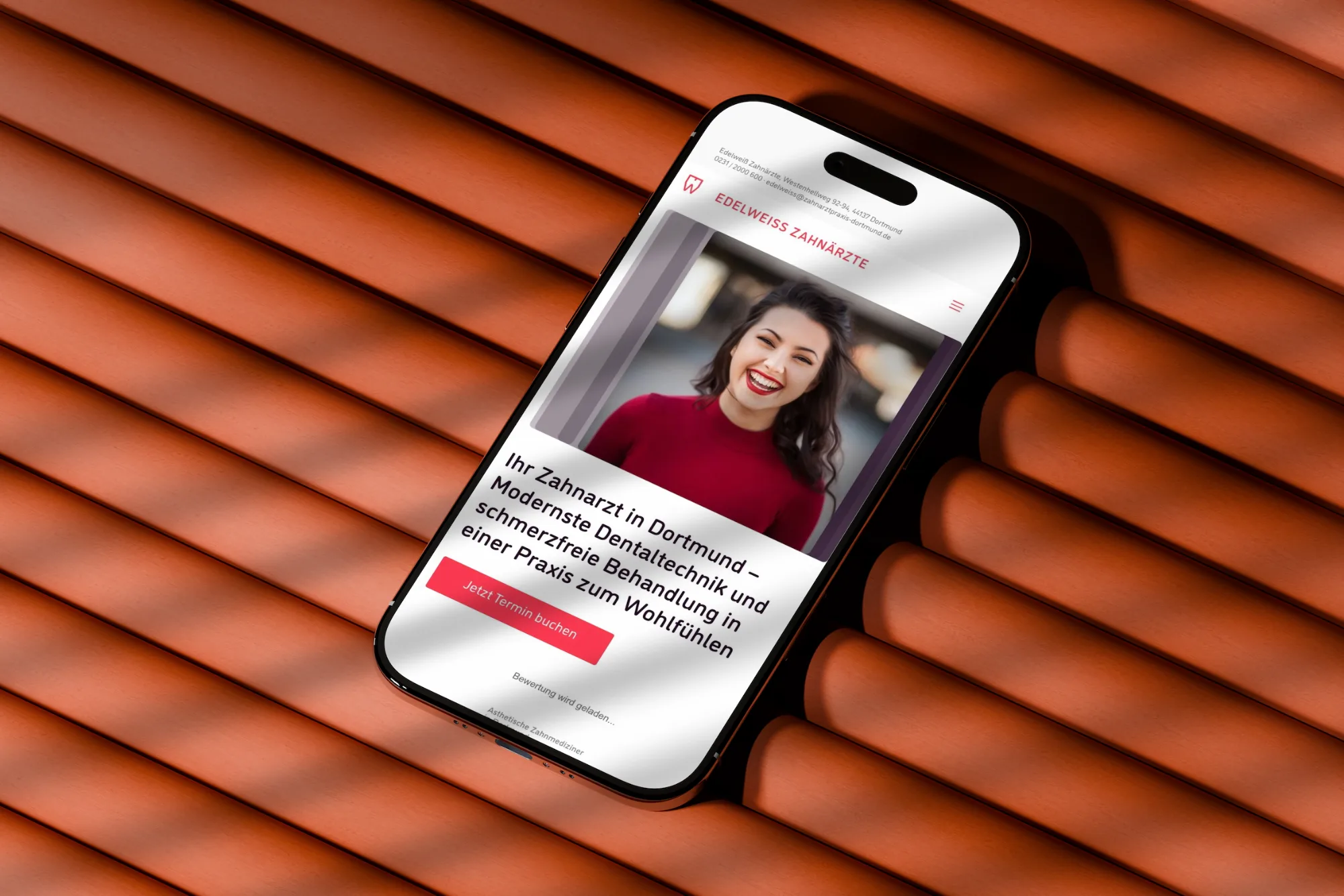
Our project with Edelweiß Zahnärzte in Dortmund shows what a modern practice website can look like. The practice wanted to position itself as a premium destination for high-quality dentistry and needed a website that conveys this positioning in every pixel.
We built the website in Webflow, with an animated banner in the header that elegantly visualizes modern dentistry, intuitive navigation, clear service pages, and seamless Doctolib integration for online appointment booking. The authentic imagery shows the real team and the real premises, not stock photos. The result: a website that builds trust, wins patients, and reinforces the practice's premium positioning at every touchpoint.
Why Webflow is ideal for practice websites
Many practices still run on outdated WordPress installations or generic website builders. Both have structural drawbacks: WordPress requires ongoing maintenance, security updates, and plugin management. These are tasks nobody in a practice is responsible for. Generic website builders offer little design freedom and lead to cookie-cutter results.
Webflow solves both problems. It offers professional, agency-level design freedom combined with a low-maintenance CMS that practice teams can run themselves. Webflow handles updates, security, and hosting. The practice has nothing to worry about. Content such as team members, services, or blog posts can be managed without any coding skills. And out of the box, performance is significantly better than with traditional WordPress installations.
Common mistakes on practice websites
Many dental practices make typical mistakes with their websites that cost them patients.
Mistake 1: Too much text, too little structure
Long, unstructured blocks of text put visitors off. Patients scan websites; they don't read them. Clear headings, short paragraphs, bullet points, and visual elements make content digestible.
Mistake 2: Stock photos instead of real images
Generic photos of smiling models with perfect teeth look fake and interchangeable. A professional photo shoot of the real team and the real premises is the best investment in the quality of your website.
Mistake 3: Hidden contact information
Phone number, address, office hours, and booking link must be immediately visible on every page, not three clicks away on the “Contact” subpage. Patients who can't find a piece of information right away leave the site.
Mistake 4: No local SEO
Many practices forget that, above all, they need to be found locally. If you don't show up in Google Maps and local search, you systematically lose patients to better-optimized competitors. A well-maintained Google Business Profile and structured data on the website are a must.
Mistake 5: No clear conversion strategy
A practice website has one goal: generating appointment bookings. If you lose sight of this goal and turn your website into a purely informational site, you're wasting potential. Every page should have a clear call to action for booking an appointment.
What does a professional practice website cost?
The cost of a professional practice website varies depending on scope. A solid, modern website with all the key features starts at around €5,000 to €8,000. If you also need a professional photo shoot, custom design, multilingual content, or complex integrations, you'll quickly end up in the range of €10,000 to €20,000.
What matters is perspective: a practice website is not an expense but an investment. If it wins even a single additional patient per month, it usually pays for itself within a few months. And a well-made website lasts 5 to 7 years before it needs a fundamental overhaul again.
Conclusion: Your website is your practice's most important marketing channel
At a time when patients look for their practice online, the website is a dental practice's most important marketing channel. It decides whether a searcher books an appointment or clicks through to the next competitor. And it is the centerpiece of the practice's digital brand perception.
A modern practice website is more than a digital business card. It is a trust builder, a service showcase, and a booking system in one. If you invest here, you are investing directly in patient acquisition and visibly setting yourself apart from the crowd.
At Design Republic, we develop websites for dental practices that are strategically sound, professionally designed, and technically state of the art. With Webflow as the foundation, a senior design team, and experience from projects such as Edelweiß Zahnärzte, we deliver websites that don't just look good but also measurably win patients. If you'd like to know what a modern website for your practice could look like, book a free initial consultation.