Why dental practices need a well-thought-out corporate design
The German dental market is saturated. In every major city, there are dozens of dental practices that work at a high level of expertise. It is becoming increasingly difficult for patients to make an informed choice — and this is exactly where it is decided which practice prevails. Not only professional qualification, but perceived professionalism is the decisive factor today. And perception is visually designed.
A well-thought-out corporate design is not a gimmick for dental practices, but a strategic tool. It creates trust before the first conversation takes place. It positions the practice in the market. It makes it easier to attract patients and strengthens the loyalty of existing patients. And it makes the decisive difference between an interchangeable and a memorable practice.
What patients really perceive
Before a patient enters the practice for the first time, they already have an image in their head. This image is created from many small impressions: the website, the Google entry, the logo on the practice sign, the business card from the referrer, the Instagram account or the photo in the city magazine. Each of these touchpoints sends a message — consciously or unconsciously.
The problem of many practices: These touchpoints seem random. The website looks modern but the practice sign is 15 years old. The Instagram account uses colorful stock photos, while the waiting room is decorated in subtle shades of gray. The business card shows a different logo than the website. Such inconsistencies undermine trust without patients being able to pinpoint exactly why.
A professional corporate design solves this problem by combining all touchpoints under a uniform visual language — from the first Google click to the sticker on the toothbrush bag.
The most important components of a corporate design for dental practices
Unlike a pure logo, the corporate design for dental practices is about a holistic system. These components are included.
1. Logo and word mark
The logo is at the heart of the practice brand. It should convey the values of practice — competence, trust, modernity — and work in all sizes and applications, from a small favicon to a large sign above the practice entrance. Important: A good practice logo must be timeless. It is often used for 10 to 15 years and should outlast fashion trends.
2nd color world
Colours transport emotions and shape the perception of practice. Classic shades of blue represent trust, hygiene and professionalism — they are widely used in dentistry. If you want to differentiate yourself, you can work with warm shades of green, earthy colors or subtle accents. It is important that the color scheme matches the positioning: A premium practice in an urban environment works with different colors than a family-friendly practice in rural areas.
3. Typography
Typeface is an underrated part of corporate design. It influences whether the practice appears modern, classic, friendly or reputable. Well-thought-out typography creates legibility on the website, clear signs in the practice rooms and a uniform appearance in all patient information.
4. Figurative language
Stock photos of laughing models with perfect teeth are the fastest way to make a practice look interchangeable. Authentic imagery shows the real practice team, the real rooms, the real atmosphere. Professional photo shoots are worthwhile for any practice that wants to take a serious stand.
5. Practice rooms and control system
The corporate design doesn't end at the screen. It runs through the practice rooms: wall colors, furniture, signs, door signs, signposts. A well-thought-out guidance system helps patients orient themselves — and at the same time conveys the brand values of the practice.
6. Office equipment and patient supplies
Business cards, stationery, medical history sheets, appointment cards, prophylaxis passes, prescription templates, educational folders, shopping bags — the list of materials that need a uniform design is long. Each of these materials is an opportunity to communicate the brand consistently.
7. Practice clothes
The work clothes of the practice team are also part of the corporate design. Uniform, high-quality clothing strengthens team spirit and provides patients with professionalism. The colors and materials should match the overall brand.
Case study: Edelweiss dentists
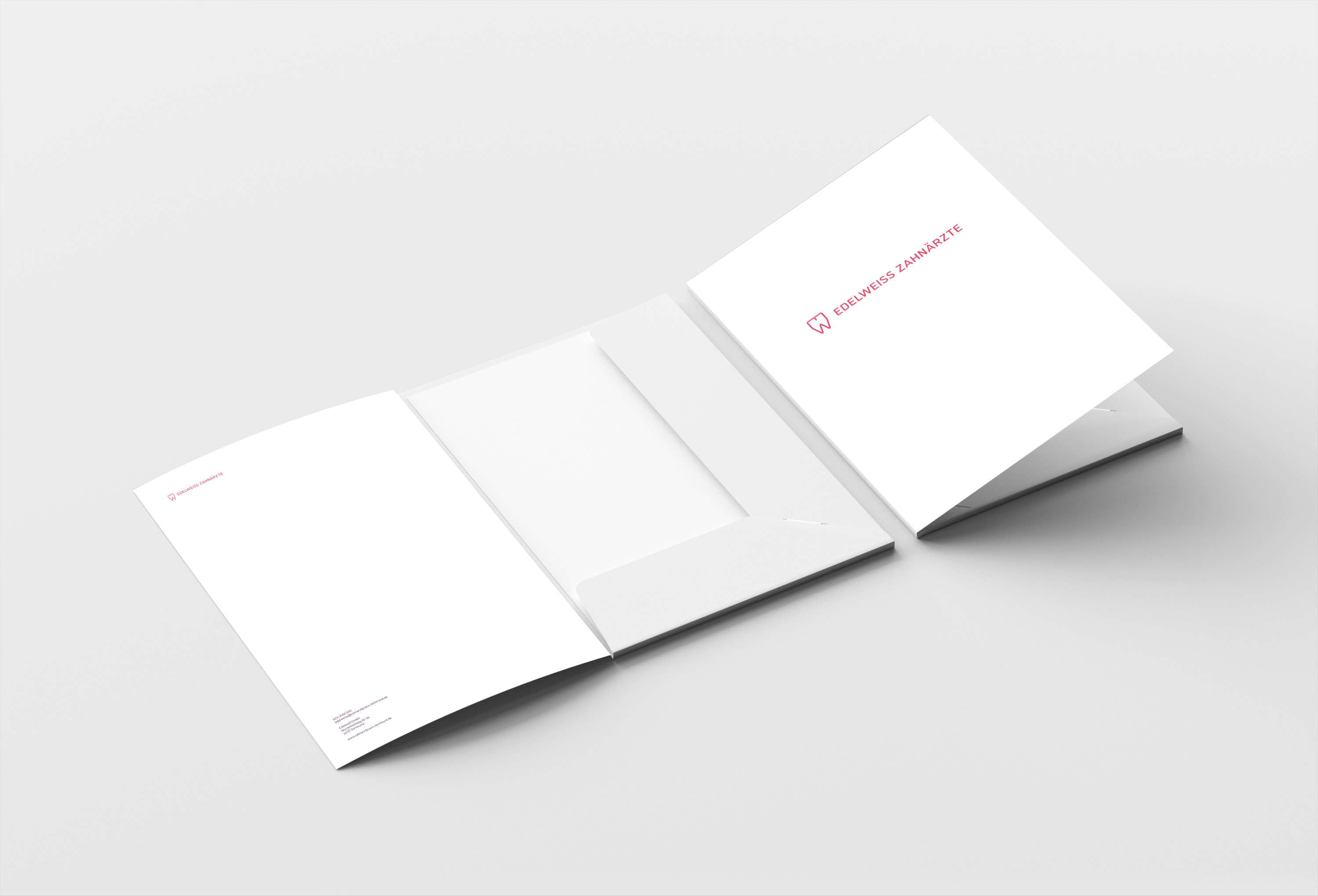
Our project with Edelweiss dentists in Dortmund shows what a holistic corporate design for a dental practice can look like. The practice wanted to position itself as a premium point of contact for high-quality dentistry — and needed an image that conveys this positioning at every touchpoint.
We have developed a complete design system for Edelweiss: from the logo to a characteristic color scheme in soothing shades of blue to complete practice equipment. This included a modern website with online appointment booking, a well-thought-out guidance system with elegant signs, uniform practice clothing, business cards, stationery, medical history sheets, prophylaxis passports and carrying bags. More than 30 different design elements have been coordinated — the result is a consistent brand perception that accompanies patients from the first digital contact to the last detail in practice.
This shows that corporate design for dental practices is not a logo project. It is a holistic process that combines strategy, design and consistent implementation.
Common mistakes in practice branding
Many dental practices invest in individual design measures without looking at the big picture. This leads to typical mistakes.
Mistake 1: The logo update as a branding project
A new logo alone does not make a brand. Anyone who only reworks the logo without adapting the website, signage, printed matter and visual language loses consistency and thus recognition value. Branding must be thought of holistically.
Mistake 2: Stock photos instead of real imagery
Generic stock photos of flawless models look interchangeable and fake. Authentic photos of the real team and the real rooms create trust and differentiation.
Mistake 3: Too many trends, too little substance
What is fashionable today will look old-fashioned in five years. Practical branding should be timeless and not based on short-term design trends. A practice does not invest in a rebrand every two years.
Mistake 4: Inconsistency between digital and analog
The website looks modern, but there are yellowed notices in Comic Sans in the waiting room. Such breaks undermine brand perception. Digital and analog touchpoints must be coordinated.
Mistake 5: No clear positioning
A good corporate design requires a strategic basis. Who is the target group? What is the promise of practice? What does it stand for? Without answers to these questions, the design remains arbitrary — and arbitrariness is the biggest competitive disadvantage in the market.
When is a corporate design worthwhile for your practice?
There are typical situations in which investing in a corporate design pays off particularly well.
In the case of a Establishment of a new practice Is corporate design mandatory. Anyone who sets up a new practice has the unique opportunity to establish a consistent appearance right from the start — instead of expensive improvements later on. In the case of a Practice takeover Does a rebrand often make sense in order to visually communicate the change of ownership and to move away from the old image. With a repositioning — for example, if the practice specializes in certain services such as implantology, aesthetics or pediatric dentistry — the visual appearance must support this positioning. In the case of a widening With new rooms, locations or treatment areas, a scalable design system is becoming a necessity. And with a general obscuration The visual identity — when the logo, website or practice rooms no longer match the professional quality — a refresh is overdue.
How much does corporate design cost for a dental practice?
The costs vary greatly depending on the scope. A very rough guide: A basic package with logo, color scheme, business cards and a simple website starts at around 5,000 euros. A complete corporate design, including practice equipment, signage, patient material and professional photography, is generally between 15,000 and 30,000 euros. Premium projects for several locations or particularly complex concepts can also be significantly higher.
The perspective is important: A corporate design often accompanies a practice for 10 years or more. In terms of useful life, the investment is manageable — and it pays off many times over through higher patient recruitment, stronger retention and a more professional appearance.
Conclusion: Corporate design is the best investment in your practice brand
A well-thought-out corporate design is not a luxury for dental practices, but a strategic necessity. In a saturated market, perceived professionalism determines which practice wins patients and which remains interchangeable.
The good news: Corporate design is a one-off basic investment that pays off over years. Anyone who has set up the brand properly once benefits from greater recognition, more trust and a clear positioning in the market.
At Design Republic, we support dental practices from strategic brand development to complete implementation — from logo and website to practice equipment and signage to patient material and practice clothing. We know what's important in the dental industry and implement it with a senior design team. If you want to know what a corporate design for your practice could look like, then book a non-binding demo.